
NeuroHCI
Integrating Neuroscience and Human-Computer Interaction
A meet-up to bring together researchers and practitioners interested in the timely intersection of neuroscience and human–computer interaction.
Read Proposal
About the Meet-up
This meet-up will bring together researchers and practitioners interested in the timely intersection of neuroscience and human–computer interaction (NeuroHCI). Advances in performance and accessibility of methods such as EEG, fNIRS, BCIs, and biosensing open new possibilities for design and interaction while also raising conceptual, technical, and ethical challenges. The session will employ engaging, interactive activities to maximize dialog, including an exercise that invites participants to experience embodied approaches to interaction. Our goal is to catalyze interdisciplinary collaboration, strengthen and grow the NeuroHCI community, and identify promising directions for future research and practice.
Join the NeuroHCI Community
Connect with other researchers and practitioners in our Slack channel to share ideas and collaborate before, during, and after CHI 2026.
Join our SlackAgenda
Informal Schedule of Activities
Welcome & Pin Ice-breaker
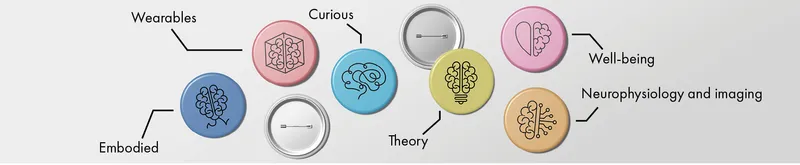
0-10 minOrganizers will welcome each participant and let them pick pins to add to their lapel based on their personal interests (e.g., EEG, fNIRS, Soma design, Well-being). These pins serve as prompts to spark conversation among strangers.
“Mix the neurons” Networking
10-50 minA speed-dating style rotation where organizers present open-ended prompts, such as 'everyone with a wearable pin should talk to someone with a well-being pin.' This encourages unexpected discussions between people who wouldn't necessarily have networked.
Body-mind Activity
50-80 minAn exercise aimed at initially turning attention inward towards the body and then socially toward others using a haptic technology. This provides firsthand experience with soma-based design methods, broadening the scope of discussion beyond typical brain-centric concepts to embodied ones.
Wrap-up
80-90 minClosing remarks, summary of the session's insights, and a call-to-action for follow-up activities, enabling the community to stay connected.
Organizers

Amber Maimon
University of Bremen , University of Haifa & Ben Gurion University
Amber Maimon is a postdoctoral researcher in the Computational Psychiatry and Neurotechnology Lab at Ben Gurion University and a research fellow in the Human-Computer Interaction Lab at The University of Haifa. Amber's work centers around neuroplasticity, connections between the senses, and the body and mind. Specifically, her work focuses on these research themes and human interaction with various technologies for augmenting, reprogramming, and reverse engineering mental and cognitive states, as explored in a NeuroHCI research group she co-founded with Iddo Wald. In addition to academic publication venues, Amber's recent research has also been featured in numerous popular media outlets such as Neuroscience News, SciTechDaily, and Popular Mechanics.

Iddo Yehoshua Wald
University of Bremen
Iddo Wald is a research fellow at the Digital Media Lab in UB, supervised by Prof. Rainer Malaka. He previously co-founded a health-tech startup, then transitioned to academia to build and lead the design and technology team at Reichman University's Media Innovation Lab (milab), and helped establish the university's MA in HCI. He then joined the university's Institute for Brain, Cognition, and Technology's management team, where he co-founded a NeuroHCI research group with Dr. Amber Maimon. His current research focuses on development of novel sensory experiences based on fundamental mechanisms of sensory perception, specifically extending perception and enhancing interoception. Iddo's work has been published at top HCI conferences including CHI, DIS and TEI (Best pictorial 2021), featured in popular media, and numerous public displays.

Yudai Tanaka
University of Chicago
Yudai Tanaka is a Ph.D. student in the Department of Computer Science at University of Chicago advised by Prof. Pedro Lopes. In his research, Yudai explores computer interfaces that output sensory feedback by intercepting the user’s brain or nervous system. These interfaces free up the user’s body from hardware in touch interactions, or even envision a new form of interactive experiences by presenting sensations directly to the brain. Yudai has published work at top HCI conferences including ACM CHI/UIST, with Best Paper Award (CHI 2023), Best Paper Honorable Mention (CHI 2024, UIST 2024), and Best Demo Award (CHI 2022) & Honorable Mention (UIST 2024). His work has been covered by IEEE Spectrum and New Scientist.

Yun Ho
University of Chicago
Yun Ho is a Computer Science Ph.D. student at the University of Chicago, advised by Prof. Pedro Lopes. Their work focuses on Human-Computer Interaction (HCI), exploring how people make sense of and build relationships with physical assistance systems that communicate through proprioception. Yun Ho has published work in top HCI venues, including ACM CHI, and received a Best Paper Award at CHI 2024.

Jamie A. Ward
Goldsmiths, University of London
Jamie A Ward is a Professor of Computer Science at Goldsmiths, University of London. He received his Ph.D. in electronics from ETH Zurich, where he developed some of the first uses of multi-modal, wearable sensing for human activity recognition. He continued this work as a Marie Curie Research Fellow in Computing at Lancaster University, and later as a postdoc at DFKI Germany, and the UCL Institute for Cognitive Neuroscience. In between these posts he retrained and worked as an actor. His work centres around the convergence of technology, neuroscience, theatre, and autism, and has been funded by grants from the Royal Society and the European Research Council (ERC).

Max L. Wilson
University of Nottingham
Max L. Wilson is an associate professor and leads the Brain Data Group at the University of Nottingham. The Brain Data Group has two strands: 1) studying people with brain scanners (fNIRS), and 2) studying people living with brain scanners (consumer). Since 2012, Max has led foundational studies on using fNIRS alongside HCI methods, contributed new theories of cognitive personal informatics, created brain-controlled movies that have toured around the world, and scanned 4,000 brains during public exhibitions. Max leads the Cognitive Personal Informatics community, was CHI Papers Chair in 2023/24, sits on the CHI Conference Steering Committee, is the Associate Editor-in-Chief at the highest ranked HCI journal (IJHCS), and is a member of the IEEE Brain NeuroEthics Committee.

Kristina Höök
KTH Royal Institute of Technology
Kristina "Kia" Höök is a Professor in Interaction Design at the Royal Institute of Technology, KTH, in Stockholm, Sweden. Kia focuses on Soma Design -- a design stance that merges a naturalistic and feminist cultural position on bodies with somaesthetics. Somaesthetics is a pragmatist philosophical concept, combining soma (uniting body, emotion and mind) with aesthetics (our ability to change our somas in the aesthetic and ethical direction we want to change). The Soma Design framework translates these theories into design methods for fostering perceptual awareness and bodily engagement in iterative co-design workshops and techniques like defamiliarization, helping participants reconnect with bodily knowledge for researching new interactive technologies. Soma Design’s core aesthetic and ethical commitment, felt ethics, centres on honouring human dignity and somatic freedoms.

Pedro Lopes
University of Chicago
Pedro Lopes is an Associate Professor in Computer Science at the University of Chicago. Pedro focuses on integrating interfaces with the human body—exploring the interface paradigm that supersedes wearables. Examples of these new interfaces include muscle stimulation wearables that allow users to manipulate tools they have never seen before or that accelerate reaction time, or a device that leverages the smell to create an illusion of temperature. These interactive devices leverage computers to augment the user’s body, not just cognitively, but also physically. Most recently, Pedro is exploring how interfaces can provide assistance and promote attitude change with regards to critical societal challenges, such as reducing electronic waste. Pedro’s work has received several academic awards, such as CHI/UIST Best Papers, the Sloan Fellowship, and the NSF CAREER award.

Rainer Malaka
University of Bremen
Rainer Malaka is a Professor for Digital Media at the University of Bremen (UB) and Director of the Center for Computing Technologies at UB. Rainer's research focus is on HCI and AI. He is member of a research center on Cognitive Robotics and directs an international European project on Meaning and Understanding in Human Centered AI (MUHAI). In his research career, he worked on topics involving Neuroscience, Neural Theory of Language, Conversational User Interfaces and Natural User Interfaces. For many years he organized an international spring school (Interdisciplinary College) on AI, Cognitive Science, and Neuroscience, that aims at bridging these fields towards a holistic understanding of natural and artificial minds. Rainer's research lab at the Digital Media Lab at UB is an interdisciplinary research group active in the CHI community (CHI, CHI Play, TEI, CUI, DIS) and beyond.